


What is the Full Form of OCR? A Complete Guide
In today’s digital world, many technologies work quietly behind the scenes to make our lives easier. Optical Character Recognition, commonly known as OCR, is one such technology. Whether you’re scanning documents at work, depositing checks through your banking app, or digitizing old books, OCR technology is likely powering that process. But what exactly is OCR, and how does it impact our daily lives? Let’s dive deep into understanding this transformative technology.
Understanding the Full Form of OCR
OCR stands for Optical Character Recognition. This technology enables the conversion of different types of documents—such as scanned paper documents, PDF files, or images captured by a digital camera—into editable and searchable data. In simpler terms, OCR software can “read” text within digital images and transform it into text that computers can process.
The term “optical” refers to the visual aspect, as the technology uses light (optics) to recognize characters. “Character recognition” describes the process of identifying individual letters, numbers, and symbols within the image and converting them into machine-encoded text.
The Evolution of OCR Technology
OCR technology has come a long way since its inception. Let’s explore its journey:
Early Developments
The earliest OCR systems emerged in the early 20th century. These primitive systems could only recognize a few characters and required specifically designed fonts. The first commercial OCR system was installed at Reader’s Digest in 1954, where it was used to convert typewritten reports into computer-readable punched cards.
Middle Era
By the 1970s and 1980s, OCR technology had advanced significantly. Systems could recognize most standard fonts and achieved reasonable accuracy rates. However, they still struggled with handwriting and unusual typefaces.
Modern OCR
Today’s OCR technology is remarkably sophisticated, powered by artificial intelligence and machine learning. Modern OCR can:
- Recognize virtually any font
- Process handwritten text with increasing accuracy
- Work across multiple languages
- Maintain formatting elements like tables and columns
- Adapt to low-quality images and poor lighting conditions
How Does OCR Technology Work?
OCR technology processes images through several key steps:
- Image Acquisition: The system captures an image containing text using a scanner or digital camera.
- Preprocessing: The software enhances the image quality by adjusting brightness and contrast, removing noise, and normalizing orientation.
- Text Detection: The system identifies areas containing text versus those with graphics or blank spaces.
- Character Recognition: This is where the actual “reading” happens. Using pattern recognition algorithms, the system breaks down text into characters or even words.
- Post-processing: The recognized text undergoes correction using linguistic techniques such as spell-checking and context analysis.
- Output Generation: Finally, the system produces editable, searchable text in formats like TXT, DOC, or PDF.
Applications of OCR Technology
OCR technology has found its way into numerous industries and applications:
Banking and Finance
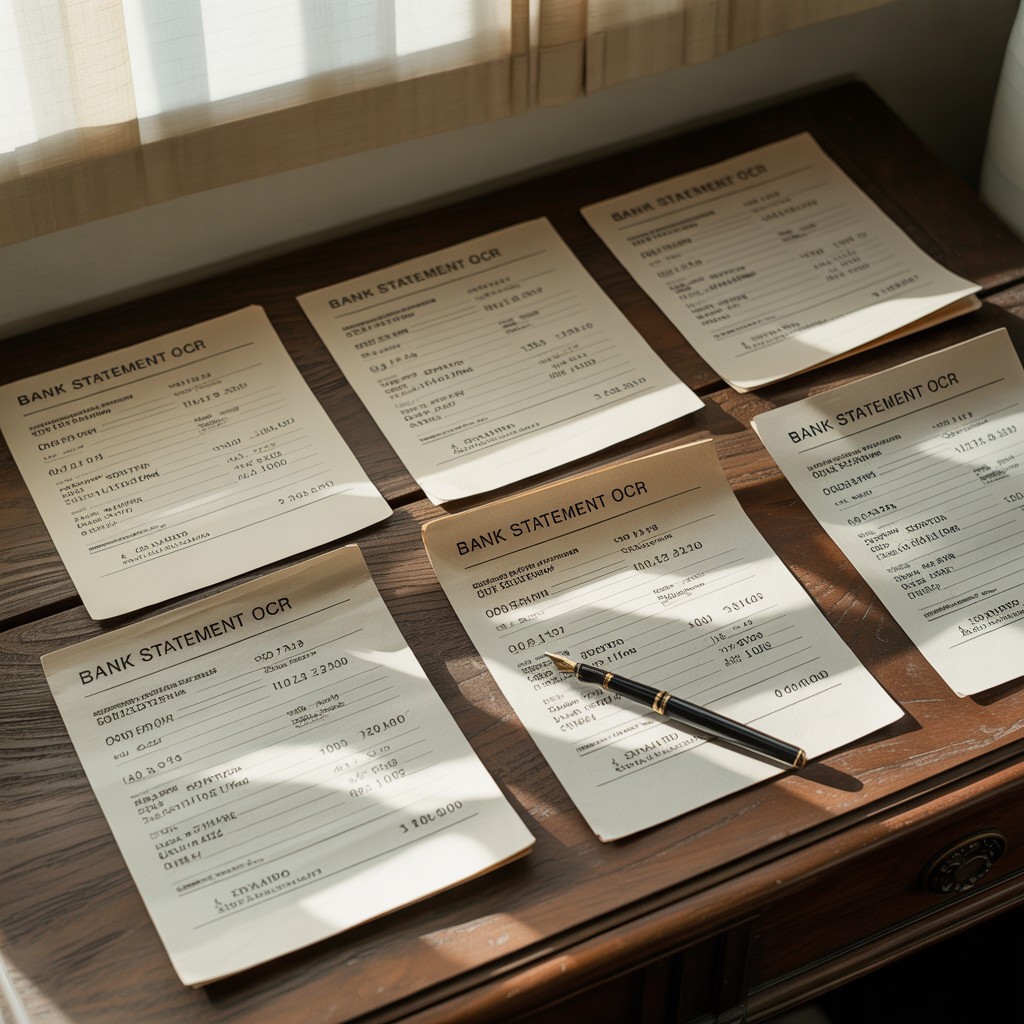
One of the most impactful applications of OCR is in the banking sector. Bank statement OCR technology has revolutionized how financial institutions process documents. When you deposit a check via your mobile banking app, OCR technology reads the handwritten or printed information, allowing for instant processing without manual data entry.
Bank statement OCR also enables automatic categorization of expenses, extraction of transaction details, and creation of searchable financial records. This technology has significantly reduced processing times and human errors in financial document management while enhancing security measures against fraud.
Healthcare
In healthcare, OCR helps digitize patient records, insurance claims, and prescription information. This improves record management and reduces medication errors through better prescription reading.
Legal Industry
Law firms use OCR to digitize case files, contracts, and legal documents, making vast amounts of information searchable and accessible.
Education and Research
OCR has been crucial in digitizing books and academic papers, making knowledge more accessible to researchers and students worldwide.
Government and Public Records
Government agencies use OCR to manage public records, tax forms, and identification documents efficiently.
Benefits of OCR Technology
The implementation of OCR technology offers numerous advantages:
Time Efficiency
Manual data entry is time-consuming and labor-intensive. OCR automates this process, reducing processing time from hours to minutes or even seconds.
Cost Reduction
By minimizing manual data entry, organizations save on labor costs while increasing throughput.
Improved Accuracy
While humans make errors during repetitive tasks like data entry, OCR systems maintain consistent accuracy levels, especially with modern AI-powered solutions.
Enhanced Searchability
Once documents are processed through OCR, their content becomes fully searchable, making information retrieval instantaneous.
Space Saving
Digital documents require no physical storage space, eliminating the need for filing cabinets and storage rooms.
Environmental Impact
By facilitating paperless workflows, OCR technology contributes to environmental conservation efforts.
Challenges in OCR Implementation
Despite its advantages, OCR technology faces certain challenges:
Recognition Accuracy
While significantly improved, OCR still struggles with poor-quality images, unusual fonts, and certain types of handwriting.
Language Support
Some languages, particularly those with complex character sets or right-to-left writing, present additional challenges for OCR systems.
Document Formatting
Preserving complex document layouts, tables, and formatting elements can be difficult during the OCR process.
Security Concerns
As with any digital system, OCR-processed documents need proper security measures to prevent unauthorized access.
The Future of OCR Technology
OCR technology continues to evolve, with several exciting developments on the horizon:
AI-Driven Improvements
Machine learning and deep learning are enhancing OCR’s ability to recognize context and improve accuracy.
Handwriting Recognition
Advances in neural networks are making handwriting recognition increasingly accurate, opening new application possibilities.
Real-Time Processing
Real-time OCR applications are emerging, allowing for immediate text recognition through smartphone cameras.
Integration with Other Technologies
OCR is being integrated with technologies like augmented reality, translation software, and voice recognition to create comprehensive solutions.
Bank Statement OCR: A Game-Changer in Financial Management
Focusing specifically on bank statement OCR, this technology has transformed financial document processing in several ways:
Automated Data Extraction
Bank statement OCR automatically extracts critical information from financial documents, including transaction dates, amounts, account numbers, and merchant information.
Expense Categorization
Modern bank statement OCR solutions can categorize expenses automatically, helping individuals and businesses track spending patterns.
Fraud Detection
By digitizing and analyzing bank statements, OCR systems can flag unusual transactions and potential fraud indicators more efficiently.
Financial Planning
The data extracted through bank statement OCR provides valuable insights for financial planning and budgeting.
Tax Preparation
Bank statement OCR simplifies tax preparation by organizing financial information and identifying tax-deductible expenses.
Conclusion
OCR technology, standing for Optical Character Recognition, has evolved from a limited text recognition tool to a sophisticated system that transforms how we handle documents across industries. From digitizing ancient manuscripts to processing bank statement OCR applications, this technology continues to bridge the gap between physical and digital information.
As machine learning and artificial intelligence advance, OCR technology will likely become even more accurate, versatile, and integrated into our daily lives. The future looks promising for this technology that quietly powers so many of our digital interactions.
What does OCR stand for?
OCR stands for Optical Character Recognition, which is a technology that converts different types of documents into editable and searchable data.
How accurate is OCR technology?
Modern OCR systems typically achieve 98-99% accuracy for high-quality printed text. Accuracy may vary for handwritten text or poor-quality images.
Can OCR read handwritten text?
Yes, modern OCR systems can read handwritten text, though accuracy depends on the clarity of the handwriting and the sophistication of the OCR software.
What industries benefit most from OCR technology?
Banking, healthcare, legal, education, and government sectors benefit significantly from OCR technology due to their heavy reliance on document processing.
How does bank statement OCR work?
Bank statement OCR captures images of financial statements, extracts relevant information like transaction details and balances, and converts this information into structured, searchable data.
Is OCR technology secure for sensitive documents?
OCR technology itself is a conversion process. Security depends on the systems and protocols implemented alongside OCR to protect the digitized information.
Can OCR work with multiple languages?
Yes, many OCR systems support multiple languages, though some complex scripts may require specialized OCR solutions.
What’s the difference between OCR and ICR?
While OCR (Optical Character Recognition) primarily focuses on printed text, ICR (Intelligent Character Recognition) specializes in recognizing handwritten text.